
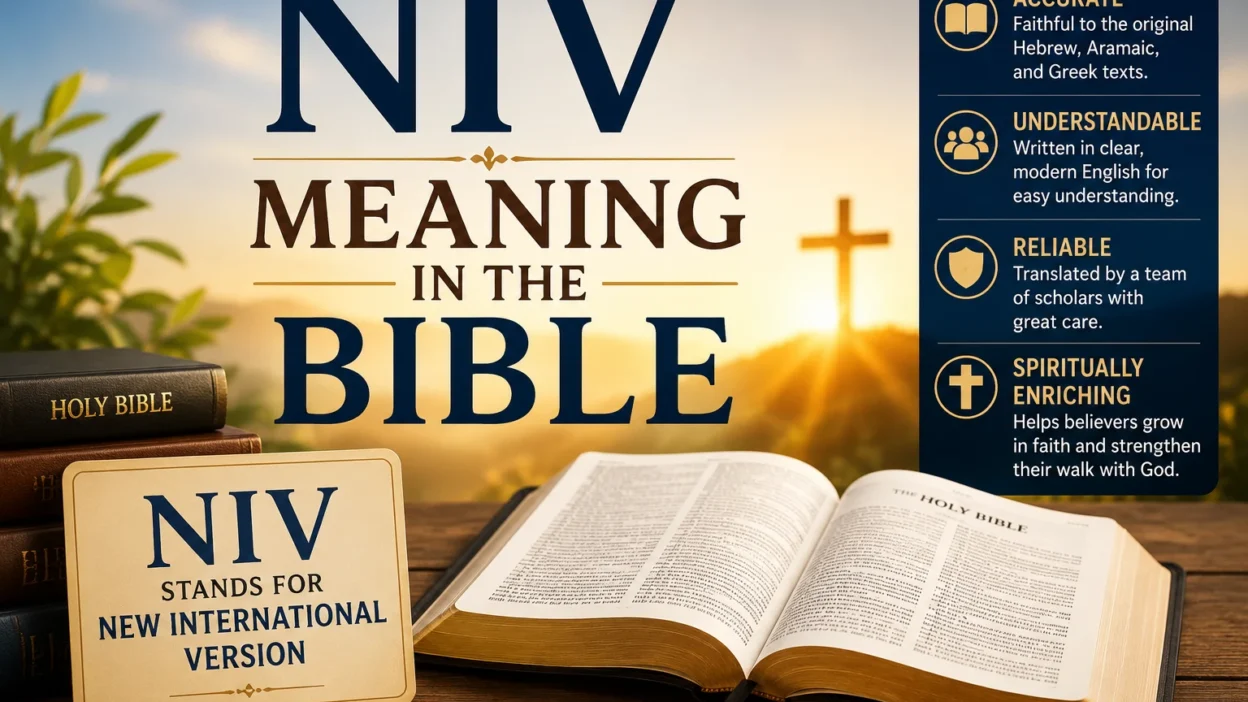
The NIV meaning in the Bible is one of the most searched topics among Christians, Bible students, and new believers. I
f you’ve ever seen the letters NIV on a Bible cover, you may have wondered what they mean and why this translation is so popular.
Understanding the NIV meaning in the Bible helps readers choose a translation that is accurate, easy to understand, and faithful to God’s Word.
The NIV meaning in the Bible goes beyond an abbreviation. NIV stands for New International Version, one of the world’s most widely read English Bible translations.
This article explains its meaning, history, purpose, spiritual significance, and how it compares with other Bible translations to help you understand why millions of Christians trust it.
Quick Answer
NIV stands for New International Version, a modern English Bible translation first published in 1978. The NIV aims to accurately communicate the original meaning of Scripture while using clear, contemporary English.
It is one of the most popular Bible translations for personal study, church worship, and daily devotion.
What Does NIV Mean in the Bible?
The NIV meaning in the Bible refers to the New International Version, an English translation created by a team of biblical scholars from different Christian denominations.
Its primary goal is to present God’s Word in language that modern readers can easily understand without sacrificing the original meaning found in the Hebrew, Aramaic, and Greek manuscripts.
Meaning Table
| Feature | Details |
|---|---|
| Abbreviation | NIV |
| Full Name | New International Version |
| First Published | 1978 |
| Language | Modern English |
| Original Sources | Hebrew, Aramaic, Greek |
| Translation Philosophy | Dynamic equivalence (thought-for-thought) |
Origin and History of the NIV
The New International Version was developed because many Christians desired a Bible that balanced accuracy with readability.
Key milestones include:
- Translation work began in the 1960s.
- More than 100 evangelical scholars contributed.
- The complete Bible was published in 1978.
- Updated editions were released in 1984 and 2011.
The translators carefully examined thousands of ancient manuscripts to ensure a reliable translation.
Is NIV Mentioned in the Bible?
No.
The letters NIV are not found anywhere in Scripture because the translation was created thousands of years after the biblical books were written.
Instead, NIV is the name of a modern English translation of the Bible—not a biblical word or person.
Why Was the NIV Created?
The NIV was designed to help readers:
- Understand the Bible more easily.
- Read Scripture in natural English.
- Study God’s Word accurately.
- Bridge the gap between literal and readable translations.
- Make the Bible accessible worldwide.
Its translators wanted people of all ages to understand the message of salvation.
Spiritual Meaning of the NIV
Although NIV itself has no symbolic biblical meaning, it carries important spiritual significance because it helps believers engage with God’s Word.
Spiritually, the NIV encourages:
- Daily Bible reading
- Spiritual growth
- Understanding biblical truth
- Stronger faith
- Personal relationship with God
The translation itself is not inspired above others, but it faithfully communicates the inspired Scriptures.
Translation Philosophy of the NIV
The NIV follows a thought-for-thought translation approach, also called dynamic equivalence.
This means translators focus on communicating the original meaning clearly instead of translating every word literally.
Advantages include:
- Easier reading
- Better understanding
- Natural English
- Excellent for new believers
- Suitable for public reading
Comparison of Popular Bible Translations
| Translation | Style | Reading Level | Best For |
|---|---|---|---|
| NIV | Thought-for-thought | Easy | Everyday reading |
| KJV | Word-for-word | Moderate | Traditional study |
| ESV | Essentially literal | Moderate | In-depth Bible study |
| NLT | Dynamic | Very easy | Beginners |
| NASB | Very literal | Advanced | Detailed study |
Each translation serves different purposes depending on the reader’s needs.
Why Is the NIV So Popular?
Millions of Christians use the NIV because it is:
- Easy to understand
- Faithful to the original text
- Suitable for churches
- Great for personal devotion
- Excellent for Bible study
- Available in many languages
Its balance between clarity and accuracy has made it one of the best-selling Bible translations worldwide.
Cultural and Modern Usage
The NIV is used by:
- Churches
- Bible study groups
- Christian schools
- Seminaries
- Families
- Mission organizations
Many pastors also quote from the NIV because listeners can easily understand its wording.
Common Misconceptions About the NIV
Some misunderstandings exist regarding the NIV meaning in the Bible.
Misconception 1: NIV is a different Bible.
False. It contains the same books as other Protestant Bibles.
Misconception 2: NIV changes God’s Word.
False. It is a scholarly translation based on reliable ancient manuscripts.
Misconception 3: NIV is the only correct translation.
Incorrect. Many trustworthy Bible translations accurately communicate Scripture.
NIV Compared with Other Translations
Comparison Table
| Feature | NIV | KJV | ESV |
|---|---|---|---|
| Language | Modern | Traditional | Modern |
| Readability | Excellent | Moderate | Good |
| Translation Style | Thought-for-thought | Word-for-word | Essentially literal |
| Popular for Beginners | Yes | Less | Yes |
| Church Use | Very common | Common | Very common |
Choosing a translation depends on your reading goals and personal preference.
Why Do People Search “NIV Meaning in the Bible”?
People often search this keyword because they want to:
- Know what NIV stands for.
- Understand its purpose.
- Compare Bible translations.
- Choose a Bible for study.
- Learn whether NIV is biblically reliable.
Many new Christians encounter the abbreviation and want a simple explanation.
Is the NIV a Good Bible Translation?
Yes.
The NIV is widely respected among evangelical Christians and Bible scholars.
It is especially helpful for:
- Daily devotions
- Family reading
- Church services
- Youth ministry
- New believers
- Personal Bible study
Its clear language makes Scripture accessible without losing its central message.
Final Summary
The NIV meaning in the Bible refers to the New International Version, a trusted English Bible translation created to make Scripture understandable for modern readers.
Although NIV is not a biblical word or name, it plays an important role in helping millions of people read and understand God’s Word.
Its balance of accuracy, readability, and faithfulness has made it one of the world’s most widely used Bible translations.
if you are a new believer or an experienced student of Scripture, the NIV offers a reliable way to grow in faith and deepen your understanding of God’s message.
Final Thought
The New International Version reminds us that God’s truth can be communicated clearly across cultures and generations.
While no translation replaces the original biblical languages, the NIV faithfully presents Scripture in everyday English so readers can better understand God’s promises, commands, and plan of salvation.
Choosing the right Bible translation should encourage consistent reading and spiritual growth.
The most important step is not simply owning a Bible but reading it, applying its teachings, and allowing God’s Word to transform your heart and daily life.
FAQs
What does NIV stand for in the Bible?
NIV stands for New International Version.
Is NIV mentioned in the Bible?
No. It is the name of a modern English Bible translation.
Is the NIV accurate?
Yes. It is translated by qualified biblical scholars using ancient manuscripts.
Is NIV good for beginners?
Yes. Its clear language makes it one of the best translations for new readers.
What translation style does NIV use?
It follows a thought-for-thought (dynamic equivalence) translation philosophy.
Is NIV accepted by Christians?
Yes. It is widely accepted by many evangelical churches and Christian organizations.
Which is better, NIV or KJV?
Both are respected translations. NIV is easier to read, while KJV uses traditional English.

Daniel Jack is a passionate writer at BibleIntent, dedicated to exploring biblical meanings, spiritual symbolism, and faith-based insights. He helps readers discover deeper spiritual understanding through scripture, signs, and interpretations.