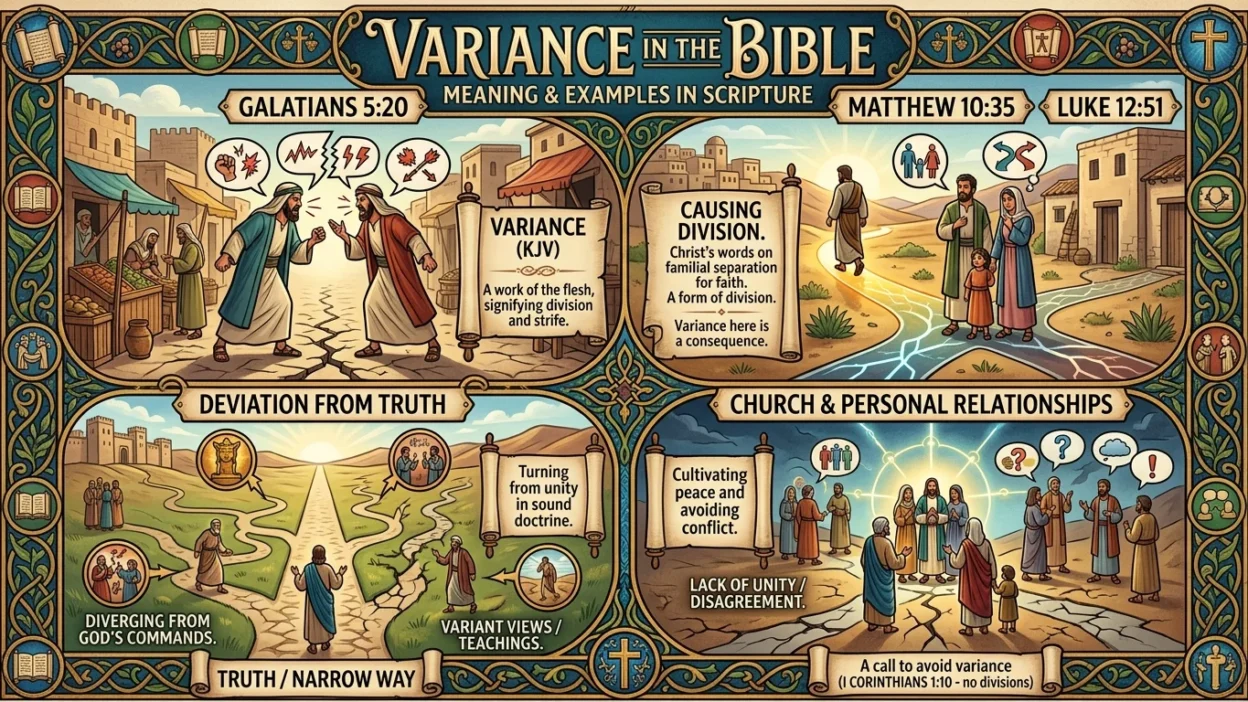
The variance meaning in the Bible is an important topic for Christians seeking to understand how Scripture views conflict, disagreement, and division among people.
Although the word “variance” is not commonly used in modern conversation, it appears in older Bible translations, especially the King James Version (KJV), where it refers to strife, discord, quarrels, or hostility.
Understanding the variance meaning in the Bible helps believers recognize behaviors that damage relationships and hinder spiritual growth.
Studying the variance meaning in the Bible also reveals God’s desire for peace, unity, forgiveness, and love among His people.
Throughout Scripture, believers are encouraged to avoid unnecessary conflict and instead pursue reconciliation through Christ.
This article explores the biblical definition, historical background, spiritual symbolism, and practical lessons of variance in a clear and easy-to-understand way.
Quick Answer
The variance meaning in the Bible refers to disagreement, strife, conflict, or division between people.
In the New Testament, variance is listed among the works of the flesh, showing that God calls believers to replace conflict with love, peace, and unity through the Holy Spirit.
What Does Variance Mean in the Bible?
In biblical language, variance means conflict, quarrels, hostility, or continual disagreement between individuals or groups.
The word appears primarily in older English translations, where it describes sinful attitudes that create division within families, churches, and communities.
Rather than promoting peace, variance encourages jealousy, anger, and broken relationships.
Meaning Table
| Term | Biblical Meaning |
|---|---|
| Variance | Strife, conflict, disagreement |
| Opposite | Peace and unity |
| Category | Work of the flesh |
| Spiritual Lesson | Pursue reconciliation |
| Biblical Focus | Harmony among believers |
Origin and History of the Word Variance
The English word variance comes from the Latin variare, meaning “to differ” or “to change.” Over time, it came to describe disagreement or conflict between people.
In older English Bibles, especially the King James Version, variance was commonly used to translate Greek words referring to rivalry, contention, and hostility.
Modern Bible translations often replace “variance” with words such as:
- Discord
- Strife
- Quarreling
- Dissension
- Conflict
Although the wording has changed, the biblical teaching remains the same.
Where Does Variance Appear in the Bible?
The best-known passage is Galatians 5:19–21, where Paul lists the works of the flesh.
The King James Version includes:
“Hatred, variance, emulations, wrath, strife…”
Here, variance refers to ongoing conflict that comes from sinful human desires rather than God’s Spirit.
This passage teaches believers to reject attitudes that divide people.
Biblical Meaning of Variance
The variance meaning in the Bible goes beyond simple disagreement.
Not every difference of opinion is sinful. Instead, biblical variance describes conflict fueled by pride, jealousy, selfish ambition, or anger.
Examples include:
- Constant arguing
- Bitter rivalry
- Personal hostility
- Church divisions
- Family conflicts
God desires His people to resolve differences with humility and love.
Biblical Characteristics
| Positive Behavior | Variance |
|---|---|
| Peace | Conflict |
| Unity | Division |
| Forgiveness | Bitterness |
| Love | Hatred |
| Humility | Pride |
Spiritual Meaning of Variance
Spiritually, variance represents the condition of a heart that is not fully surrendered to God’s Spirit.
It often begins with:
- Pride
- Jealousy
- Unforgiveness
- Selfishness
- Anger
When left unchecked, these attitudes grow into broken relationships.
By contrast, the Holy Spirit produces peace, patience, kindness, and self-control.
The spiritual lesson is clear: Christians are called to become peacemakers rather than troublemakers.
Variance as a Work of the Flesh
Paul lists variance among the “works of the flesh.”
These behaviors reflect humanity’s sinful nature.
Other works of the flesh include:
- Hatred
- Jealousy
- Wrath
- Seditions
- Envy
Paul contrasts these with the Fruit of the Spirit, which includes:
- Love
- Joy
- Peace
- Patience
- Kindness
- Goodness
- Faithfulness
- Gentleness
- Self-control
Choosing the Spirit helps believers overcome variance.
Examples of Variance in the Bible
Although the word itself is limited, Scripture contains many examples of conflict.
Examples include:
- Cain’s jealousy toward Abel.
- Joseph’s brothers becoming hostile toward him.
- Saul’s envy of David.
- The disagreement between Paul and Barnabas.
- Religious leaders opposing Jesus.
These stories demonstrate the destructive effects of pride and jealousy.
God’s Desire for Unity
One of the strongest biblical themes is unity among God’s people.
Jesus prayed that His followers would be one.
The New Testament repeatedly encourages believers to:
- Forgive one another.
- Bear with one another.
- Love one another.
- Live peacefully.
- Resolve disagreements quickly.
Unity reflects God’s character and strengthens the Church.
Common Causes of Variance
Understanding the causes helps believers avoid unnecessary conflict.
Common causes include:
- Pride
- Envy
- Misunderstanding
- Selfish ambition
- Lack of forgiveness
- Gossip
The Bible encourages humility as the cure for many conflicts.
Variance Compared with Godly Peace
Comparison Table
| Variance | Godly Peace |
|---|---|
| Conflict | Harmony |
| Pride | Humility |
| Anger | Patience |
| Division | Unity |
| Selfishness | Love |
The Bible consistently teaches believers to pursue peace whenever possible.
Cultural and Modern Usage
Today, the word variance is less common in everyday English.
Modern Bible translations usually use terms such as:
- Discord
- Conflict
- Quarreling
- Dissension
Despite the different wording, the biblical lesson remains highly relevant.
Families, workplaces, churches, and communities all benefit when people choose peace over conflict.
Common Misconceptions About Variance
Misconception 1: Every Disagreement Is Sin
The Bible allows respectful disagreement.
Variance becomes sinful when conflict is fueled by pride, hatred, or selfishness.
Misconception 2: Christians Never Disagree
Even faithful believers sometimes disagreed.
The difference is how they handled those disagreements—with humility and love.
Misconception 3: Peace Means Avoiding Every Conflict
Biblical peace sometimes requires honest conversations, forgiveness, and reconciliation rather than ignoring problems.
Why People Search for Variance Meaning in the Bible
Many readers encounter the word while reading older Bible translations.
Others search because they want to understand:
- Difficult biblical vocabulary
- Christian relationships
- Spiritual growth
- Church unity
- Biblical conflict resolution
Learning the biblical meaning helps believers apply Scripture to everyday life.
Final Summary
The variance meaning in the Bible refers to strife, discord, hostility, and ongoing conflict that arises from sinful attitudes rather than the guidance of the Holy Spirit. Listed among the works of the flesh in Galatians 5, variance stands in direct contrast to God’s desire for love, peace, unity, and forgiveness.
While disagreements are a normal part of life, Scripture teaches believers to handle them with humility, wisdom, and grace. By walking in the Spirit, Christians can replace division with reconciliation and reflect Christ’s love in their relationships.
Final Thought
The variance meaning in the Bible reminds believers that God values unity far more than personal pride or winning arguments. Conflict can damage friendships, families, and churches when left unresolved. Thankfully, the gospel provides a better way through forgiveness, humility, patience, and love. Every Christian has opportunities to become a peacemaker by seeking understanding, extending grace, and trusting the Holy Spirit to transform the heart.
As followers of Christ, we are called not only to avoid unnecessary conflict but also to actively pursue peace, demonstrating God’s love in every relationship and bringing glory to Him through lives marked by reconciliation and unity.
FAQs
What is the variance meaning in the Bible?
Variance means conflict, strife, discord, or ongoing disagreement between people.
Where is variance mentioned in the Bible?
It appears in Galatians 5:19–21 in the King James Version as one of the works of the flesh.
Is variance always sinful?
No. Respectful disagreement is not sinful, but hostility, pride, and division are.
What is the opposite of variance?
The biblical opposite is peace, unity, forgiveness, and love.
Why does God warn against variance?
Because it damages relationships and prevents believers from living in harmony.
How can Christians overcome variance?
By walking in the Holy Spirit, practicing humility, forgiving others, and pursuing peace.
Does modern Bible translation still use the word variance?
Most modern translations replace it with words like “discord,” “strife,” or “dissension.”